An overseas employer, university, embassy or court may ask for your Trinidad and Tobago documents to be "apostilled", "authenticated" or "legalised". These terms describe how one country confirms that a document issued in another country is genuine. Here is what they mean and how the process generally works in Trinidad and Tobago.
Requirements depend on the country and organisation receiving your document, and procedures change. Always confirm exactly what the receiving organisation needs, and check the current instructions from the Ministry of Foreign and CARICOM Affairs.
Apostille or legalisation?
An apostille is a certificate attached to a public document confirming that the signature and seal on it are genuine. It is used between countries that belong to the Hague Apostille Convention, and replaces the longer chain of legalisation. An apostille confirms the document is authentic. It does not confirm that what the document says is correct.
Legalisation is the older, longer process used for countries outside the Convention. After the document is authenticated in Trinidad and Tobago, the embassy or consulate of the destination country confirms the authentication.
The Ministry's Consular Affairs Division has said it cannot tell you which documents need authenticating. That is for the country or organisation receiving them, so ask them first.
Step one: the right original
A document can only be authenticated if it carries the original signature, stamp or seal of the Trinidad and Tobago body that issued or certified it.
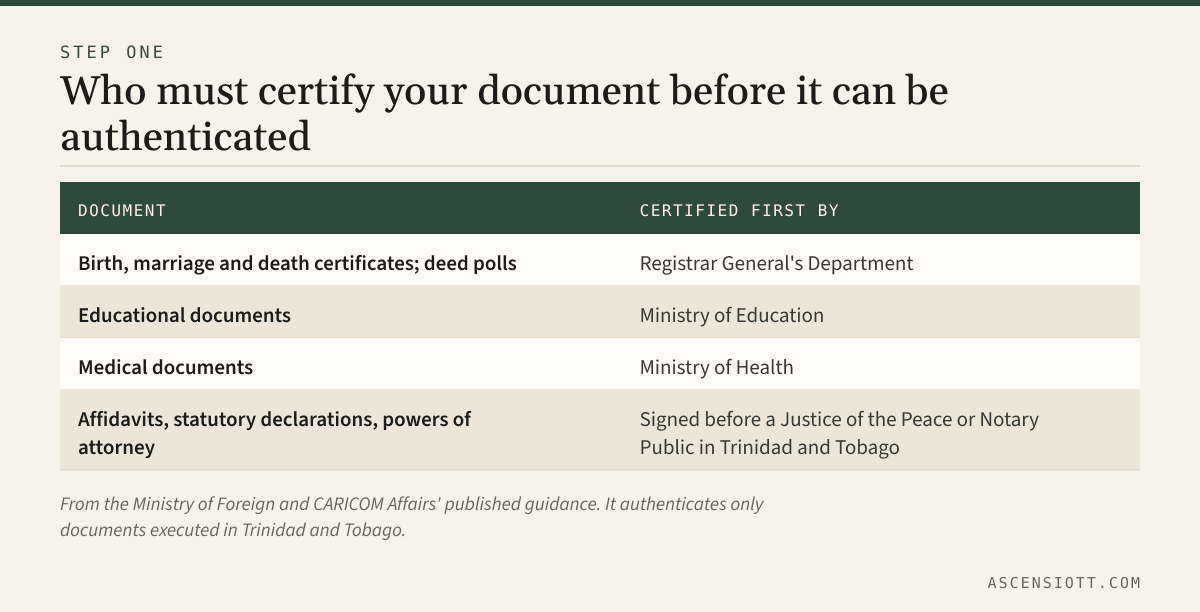
The Ministry won't accept a document without the right prior certification.
A document signed abroad is generally authenticated in the country where it was signed, not in Trinidad and Tobago.
Step two: submitting to the Ministry
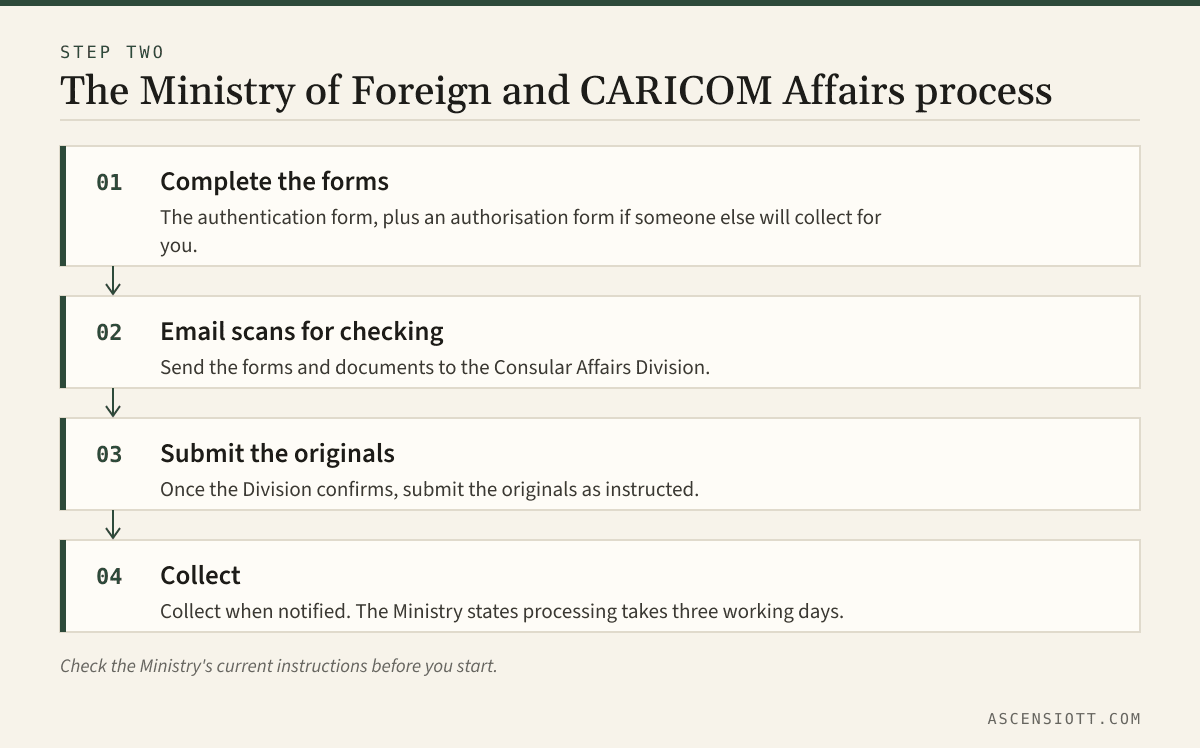
Processing takes about three working days once the originals are in.
Certificates from the RGD
For birth, marriage and death certificates, missions advise that an apostille can be requested from the Registrar General's Department when you order. If you order online, email rgdcivilonline@gov.tt with your Web Order Reference number in the subject line. Our guides to birth certificates, marriage certificates and getting certificates from abroad cover the ordering side.
Tips
- Start with the receiving organisation's exact wording. "Apostille", "notarised" and "certified copy" are not the same thing.
- Get the prior certification first. The Ministry will not accept a document without certification from the right body.
- Check whether a translation is needed for countries where English is not an official language.
- Allow extra time for each certifying office, plus courier time if you are abroad.
Having it handled at home
From abroad, the hard part is the running between offices: the RGD, the Ministry of Education, then Foreign Affairs. Our Documents from Trinidad service handles that. We check your documents against the requirements, take them to each office in the right order, and send them to you by FedEx, with updates by WhatsApp or email. A certificate with an apostille starts at US$225.
Quick answers
What is an apostille? A certificate attached to a public document confirming that its signature and seal are genuine, accepted between countries in the Hague Apostille Convention.
Where do I get a document apostilled in Trinidad and Tobago? At the Ministry of Foreign and CARICOM Affairs, after the document has been certified by the body that issued it. For RGD certificates, you can request it from the RGD when you order.
How long does authentication take? The Ministry states three working days once it has the originals.
Can a document signed abroad be apostilled in Trinidad? Generally not. It is authenticated in the country where it was signed.