When someone dies in Trinidad and Tobago, families are hit with paperwork at the worst possible time. This guide explains how a death is registered, how to get the death certificate, including from abroad, and what usually comes next, so you can see the whole sequence in one place.
The sequence at a glance
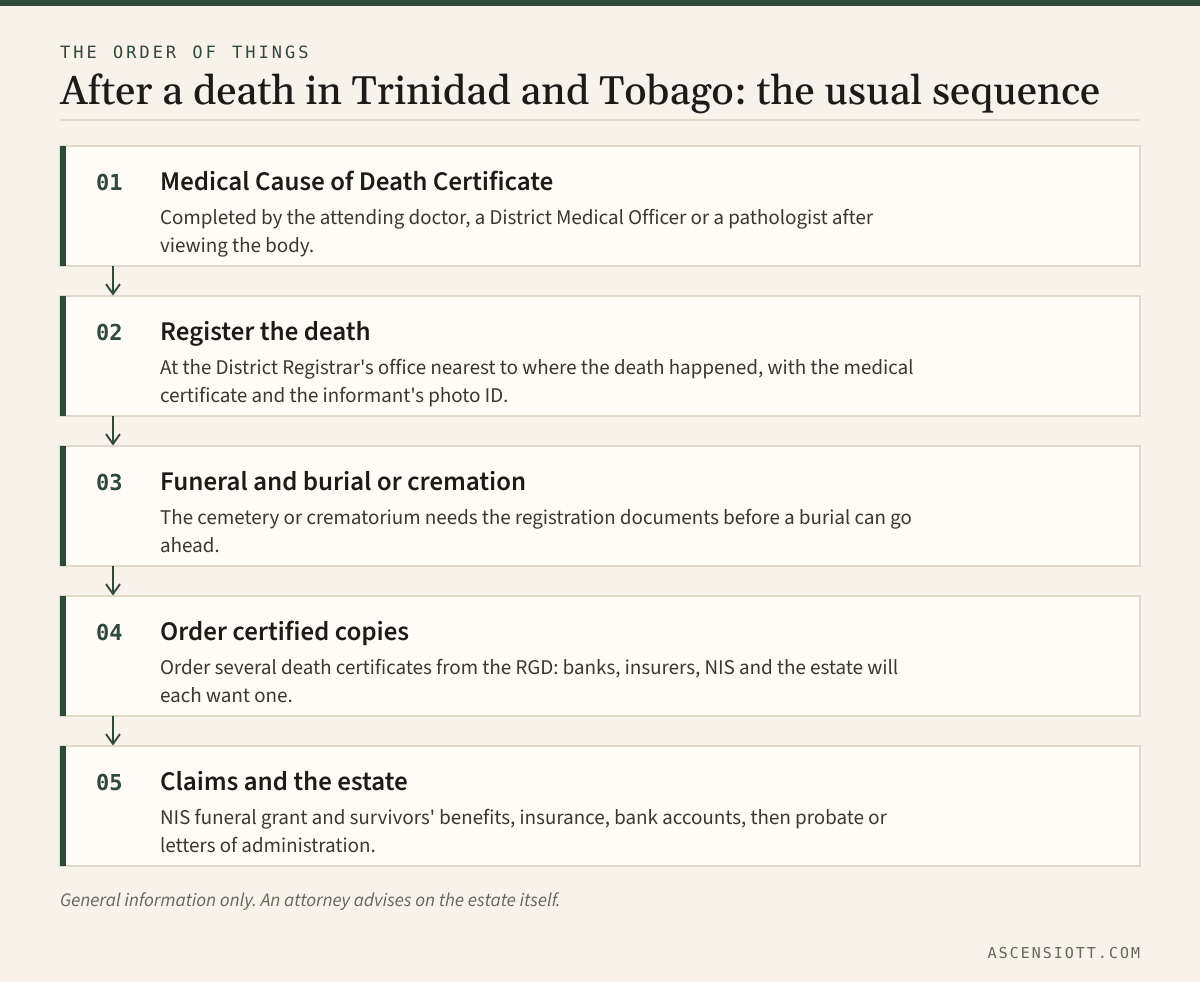
The usual order, from the medical certificate to the estate.
1. The medical certificate
A doctor must complete a Medical Cause of Death Certificate: the attending physician, a District Medical Officer or a pathologist. In January 2025 the Medical Board of Trinidad and Tobago reminded doctors that this certificate should only be issued after viewing the body. If the cause of death is unknown, sudden or unnatural, there may be a post-mortem first.
2. Registering the death
The death is registered at the District Registrar's office nearest to where it happened. The person registering, the informant, usually brings:
- the Medical Cause of Death Certificate;
- their own valid photo ID;
- the deceased's ID, such as their national ID, driver's permit, passport or computerised birth certificate, if available.
If a year or more has passed, it becomes a late registration and an affidavit explaining the delay is needed. Funeral homes routinely guide families through this step, and cemeteries won't open a grave until the death is registered.
3. Ordering death certificates
After registration you can order certified copies from the Registrar General's Department (RGD). From Trinidad and Tobago or abroad, the RGD online service asks for:
- the date of death and the deceased's first name and surname (no middle names);
- scans of two forms of photo ID (yours, from any country);
- card payment (VISA only, according to the London High Commission's 2026 guidance).
It is mailed to the address you give, including overseas. Order several copies. Banks, insurers, the National Insurance Board (NIS), employers, pension funds and the attorney handling the estate may each want a certified copy, and some keep it.
Families abroad often need an apostille for foreign banks, pension funds or courts. After ordering online, email rgdcivilonline@gov.tt with the Web Order Reference number. See our apostille guide.
4. NIS: funeral grant and survivors' benefits
If the person who died paid National Insurance, the family may be able to claim:
- Funeral Grant (form NI 8): a lump sum paid to the person who paid for the funeral, supported by the death certificate and the funeral bill or receipt. It is payable abroad.
- Survivors' Benefit (form NI 51): for a surviving spouse, qualifying common-law spouse, children and in some cases dependent parents, depending on the deceased's contributions.
The NIS claim guides list the supporting documents. Commonly: the death certificate, the claimant's ID, a marriage certificate, children's birth certificates, and if the deceased had been married before, the decree absolute or the previous spouse's death certificate. Check the current amounts and forms with the National Insurance Board (nibtt.net) before you apply.
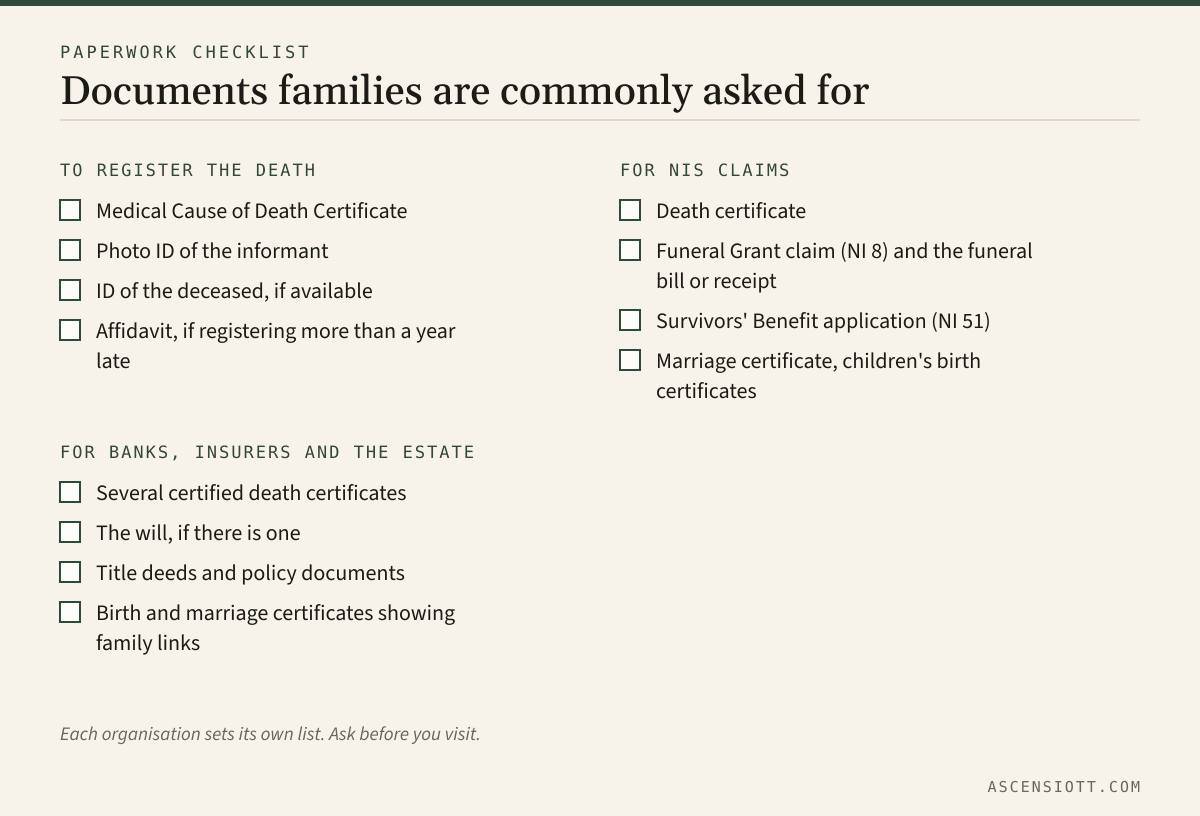
Order more death certificates than you think you need.
5. Banks, insurance and the estate
With certified death certificates in hand, the family can notify banks, insurers, credit unions and employers. Accounts in the deceased's sole name are usually frozen until someone has legal authority to deal with them. That authority comes from:
- a grant of probate, where there is a will and named executors; or
- letters of administration, where there is no will.
Both come from the High Court, and an attorney usually prepares the application. Land and property are often the most complicated part, especially when the family lives abroad. Our guide to handling property and estates from abroad explains the first steps.
If you live abroad
You can order the death certificate online yourself. Being far away makes everything else harder: the registration, the funeral, the NIS office, the bank visits. Many families have one person in Trinidad do the in-person steps, with the rest of the family supporting from abroad.
How we can help
We don't arrange funerals, and we are not a law firm. We do take on the paperwork around them: ordering and apostilling death certificates, collecting relatives' certificates to prove family links, gathering documents for NIS claims, and assembling an estate document pack for your attorney. See Documents from Trinidad (from US495) or our estate paperwork service.
Quick answers
Where do I register a death in Trinidad? At the District Registrar's office nearest to where the death occurred, with the Medical Cause of Death Certificate and the informant's photo ID.
How do I get a copy of a death certificate in Trinidad? Order it from the RGD, online at rgd.legalaffairs.gov.tt or at an RGD office, using the date of death and the deceased's first name and surname.
Can I order a Trinidad death certificate from abroad? Yes. The RGD online service accepts foreign ID and card payment, and mails certificates overseas.
What is the NIS funeral grant? A lump sum paid by the National Insurance Board to the person who paid for the funeral of an insured person. Claim it on form NI 8 with the death certificate and the funeral bill.
How many death certificates should I order? Usually several. Banks, insurers, NIS, pension funds and the estate attorney may each want a certified copy.