Stamp duty is usually the largest cost after the price itself when you buy property in Trinidad and Tobago. It is charged on the deed, paid before the deed can be registered, and worked out in bands, so the rate you hear quoted is rarely the rate you pay on the whole price.
How the bands work
Each rate applies only to the part of the price that falls inside its band, in the same way income tax works. For a residential house and land the bands are:
- Up to TTD 850,000: 0%
- TTD 850,000 to TTD 1,250,000: 3%
- TTD 1,250,000 to TTD 1,750,000: 5%
- Above TTD 1,750,000: 7.5%
Example: on a house bought for TTD 1,500,000, the first TTD 850,000 is free, 3% applies to the next TTD 400,000 (TTD 12,000) and 5% to the last TTD 250,000 (TTD 12,500). The duty is TTD 24,500, about 1.6% of the price.
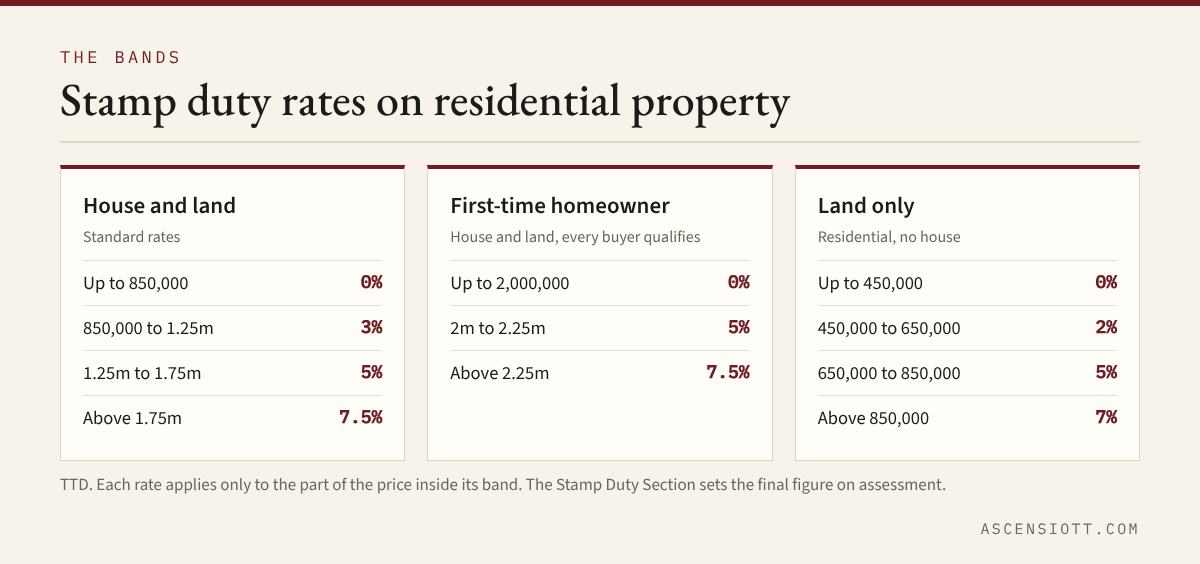
Each rate applies only to the part of the price inside its band.
First-time homeowners
A first-time homeowner buying a house and land pays no duty on the first TTD 2,000,000, then 5% on the part up to TTD 2,250,000 and 7.5% above that. Every joint purchaser must be a first-time homeowner, and each signs a declaration. If one of them is not, the standard bands apply to the whole purchase.
Example: a first-time homeowner paying TTD 1,870,000 pays no duty. The same purchase at the standard rates would cost TTD 46,000 in duty.
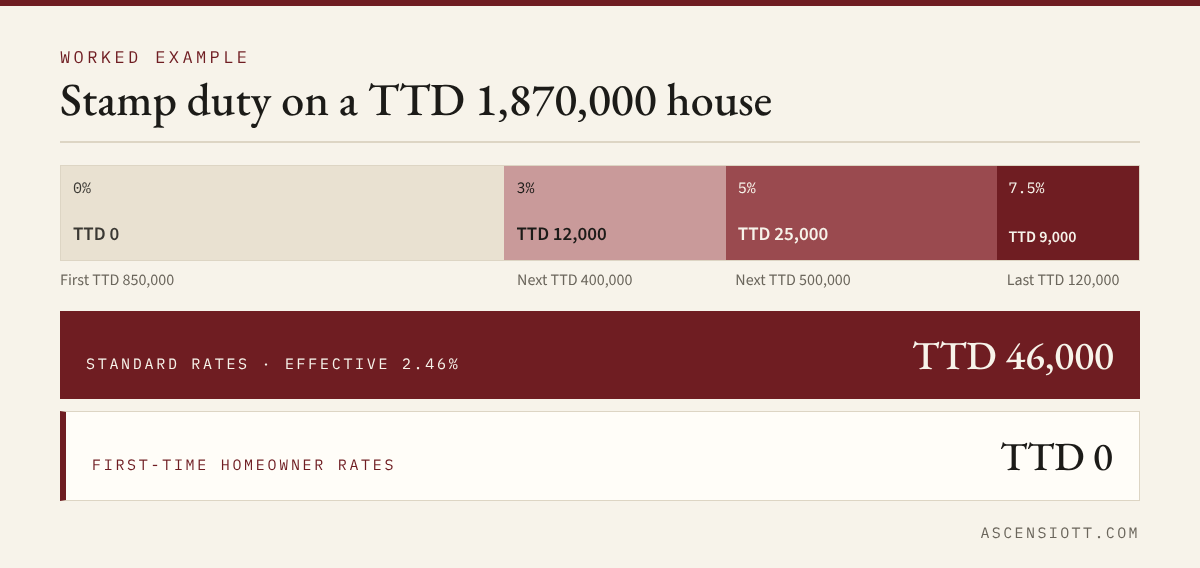
The same purchase at the standard and first-time homeowner rates.
Land without a house
Residential land on its own has its own bands: 0% up to TTD 450,000, 2% to TTD 650,000, 5% to TTD 850,000 and 7% above. On a lot bought for TTD 700,000 the duty is TTD 6,500. The first-time homeowner rates do not apply to land alone.
Deeds of gift
A gift of property can also attract duty on its value. Some gifts are not dutiable, and those are registered without an assessment. Your attorney will tell you which applies.
How the duty is assessed and paid
- The executed deed and an affidavit of due execution, sworn before a Commissioner of Affidavits, are lodged with the Stamp Duty Section of the Inland Revenue Division for assessment.
- The Stamp Duty Section usually asks for the Land and Building Taxes receipt, a valuation report under 6 months old, a WASA bill under 3 months old and the parties' BIR numbers where they have them.
- Assessment usually takes 5 to 9 working days. The Section sets the final figure, which can differ from an estimate if it values the property differently.
- Once the duty is paid, the deed is stamped and can be lodged at the Registrar General for registration. A certified copy usually follows 5 to 7 working days later.
Work it out
Our free stamp duty calculator shows the duty band by band, with first-time homeowner and land-only options, and what it costs to have Ascensio handle the stamping and registration.
Quick answers
Who pays the stamp duty? Usually the purchaser, or the person receiving the gift.
Is the first TTD 850,000 always free? On a residential house and land at the standard rates, yes. Each rate above it applies only to the part of the price in its band.
Does the first-time homeowner exemption need the property to be my home? The Inland Revenue Division says the property does not have to be owner-occupied, but every purchaser must be a first-time homeowner.
How long does stamping take? Assessment usually takes 5 to 9 working days, then payment, stamping and registration follow.
Ascensio Legal Support stamps and registers deeds for attorneys and their clients in Port of Spain, from lodging for assessment to the certified copy. Ascensio is not a law firm and does not give legal advice.