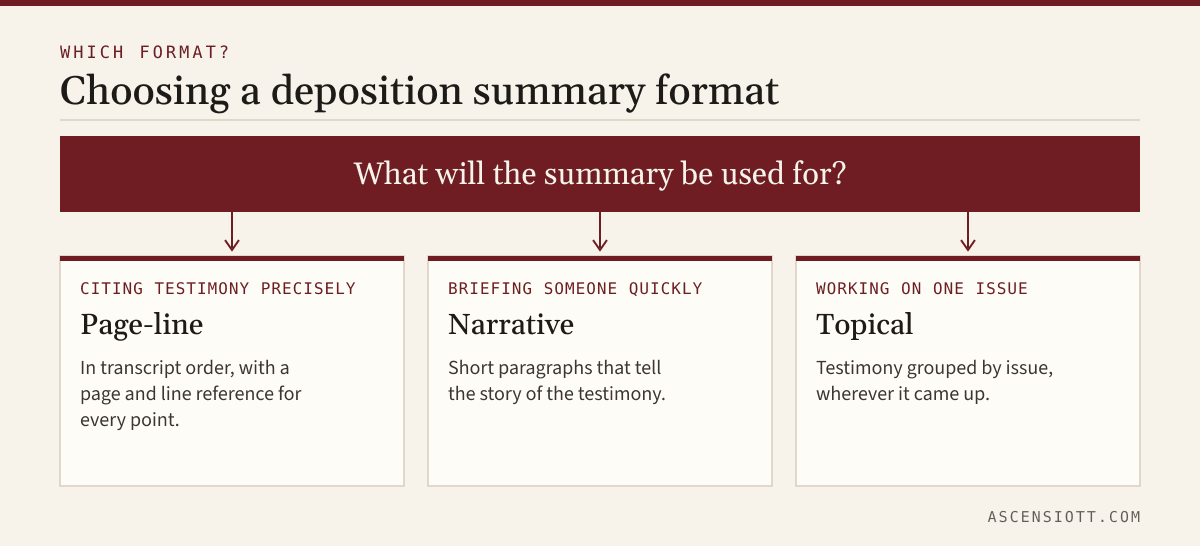
A deposition transcript can run to hundreds of pages. A good summary lets an attorney find the testimony that matters in minutes, prepare for a hearing or mediation, and brief a partner or client without rereading the whole thing. There are three common formats, and each suits a different job.
Many teams order a page-line summary plus a short topical one.
Page-line summaries
A page-line summary works through the transcript in order and notes the substance of the testimony with a page and line reference for each point.
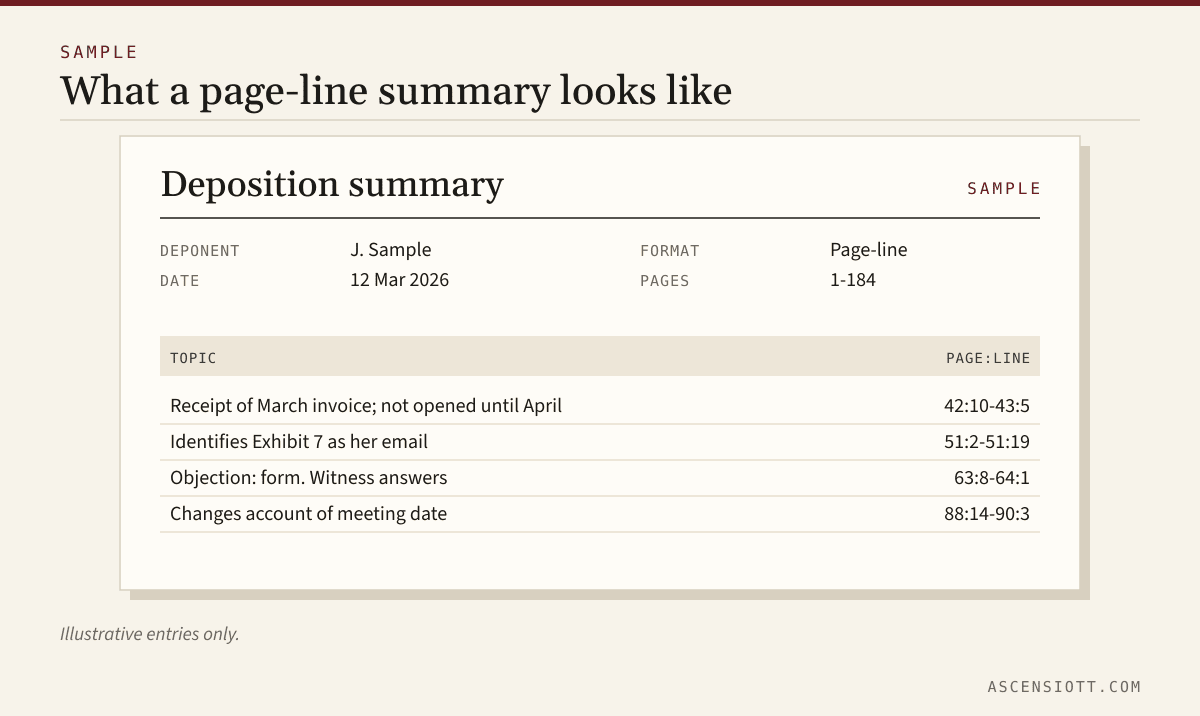
Every point can be checked against the transcript.
Page-line summaries are best when:
- you need to cite testimony precisely in a motion or at trial;
- the deposition is long and you want a quick index to it;
- several people on the team will use the same transcript.
Narrative summaries
A narrative summary tells the story of the testimony in short paragraphs, usually following the order of the questioning. It reads more easily than a page-line summary and is useful for briefing someone who hasn't read the transcript, such as a supervising attorney, an insurer or a client. Page references can still be added at the end of each paragraph.
Topical summaries
A topical summary groups the testimony by issue rather than by page: liability, damages, timeline, prior injuries, document authentication and so on. Everything the witness said about one issue appears together. Topical summaries are useful when the witness jumped between subjects, when you are preparing a motion on one issue, or when you want to compare several witnesses on the same points.
What a good summary includes
- the case caption, deponent, date and attorneys present;
- admissions, inconsistencies and changes of testimony, flagged;
- objections and instructions not to answer;
- exhibits marked, and how the witness identified them;
- neutral wording that records what the witness said rather than arguing the case;
- the transcript's own page and line numbers, so every point can be checked.
How long should a summary be?
A common rule of thumb is one page of summary for every 8 to 15 pages of transcript, but the right length depends on how dense the testimony is and what the summary is for. A topical summary for a single motion can be much shorter.
A note on the attorney's role
A deposition summary is a working tool prepared for attorney review. It is not legal advice, and it does not replace the certified transcript prepared by the court reporter, which remains the record. For building a timeline from several depositions, see our guide to case chronologies.
Quick answers
What is the most common deposition summary format? Page-line, because every point can be checked against the transcript.
Can I get more than one format for the same deposition? Yes. Many teams order a page-line summary for reference and a short topical summary for a specific motion.
How long should a deposition summary be? Roughly one page per 8 to 15 transcript pages, depending on density and purpose.
Does a summary replace the transcript? No. The certified transcript remains the record.
Ascensio Legal Support prepares page-line, narrative and topical deposition summaries for US litigation teams, from US$1.95 per transcript page.