A record of appeal puts before the appellate court everything it needs to decide the appeal: the pleadings, the evidence, the judgment and the notice of appeal. A well-prepared record makes the court's job easier and lets counsel find any document instantly during argument. A poor one causes delay and, sometimes, criticism from the bench.
The exact requirements depend on the court, so always check the applicable rules, practice directions and any directions given in the appeal. This checklist covers the practical points that apply in most Caribbean appellate courts and in appeals to the Privy Council.
Requirements differ between courts. Check the rules for yours.
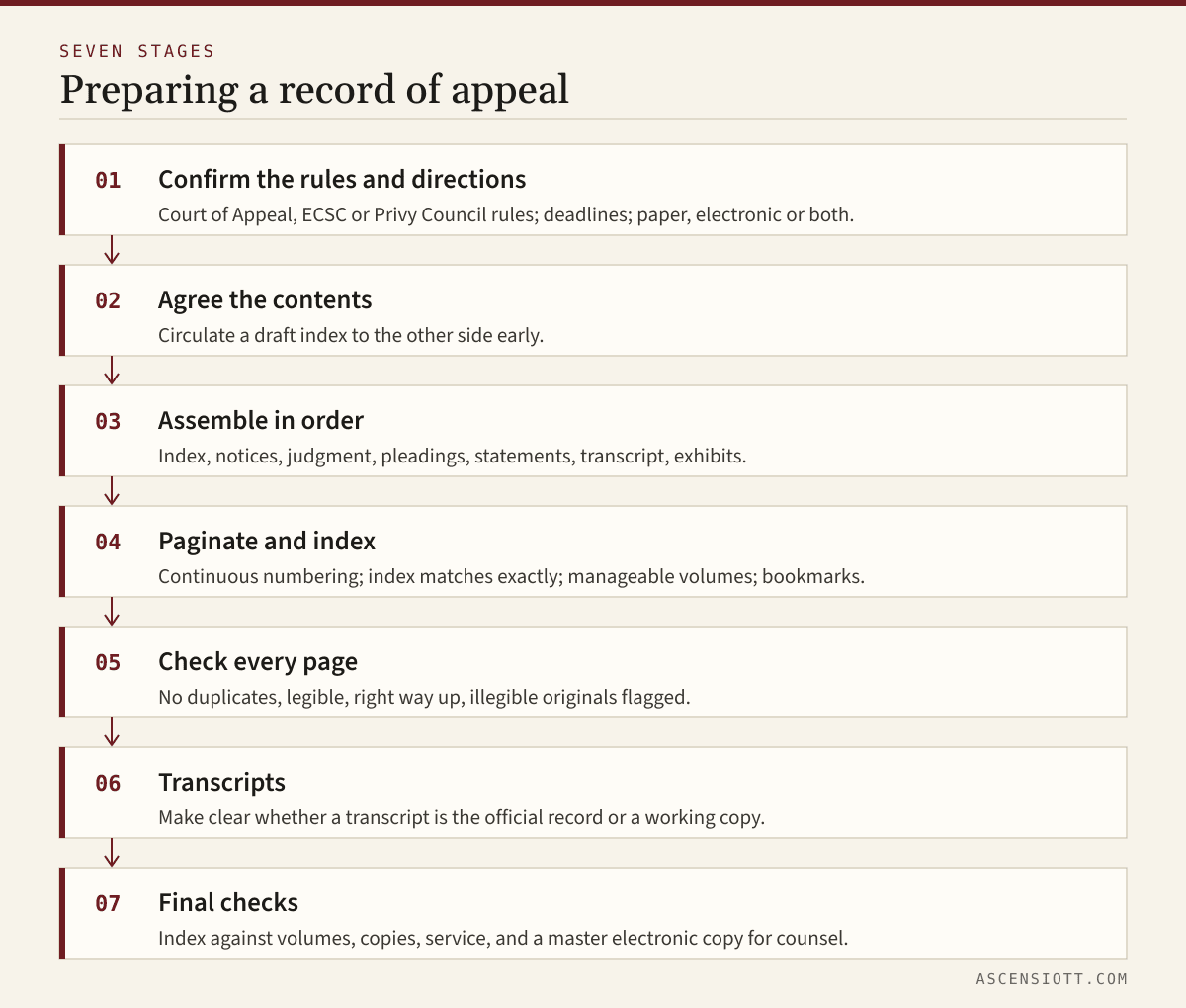
1. Confirm the rules and directions first
- Identify the rules that govern the record: the Court of Appeal rules in your jurisdiction, the Eastern Caribbean Supreme Court rules, or the Judicial Committee of the Privy Council's rules and practice directions.
- Note any deadline for filing or agreeing the record.
- Check whether the court requires hard copies, electronic copies or both, and in what format.
2. Agree the contents with the other side
The contents are usually agreed between the parties. Circulate a draft index early: disagreements about what goes in are easier to resolve before documents are copied and paginated.
3. Typical contents and order
- Index
- Notice of appeal and any respondent's notice
- Judgment or order appealed from, and the reasons
- Pleadings and relevant interlocutory orders
- Witness statements and affidavits
- Transcript or notes of evidence
- Exhibits and documents relied on
- Any further documents the court has directed
4. Paginate and index carefully
- Paginate continuously, so every page has a unique number.
- Make the index match the page numbers exactly, and recheck it after any late change.
- Divide long records into volumes of manageable size, with the index in each volume.
- In electronic copies, add bookmarks for each document and make the text searchable.
5. Check the quality of every page
- Remove duplicates unless they are needed.
- Make sure every page is legible and the right way up.
- Mark any illegible original and note where a clearer copy can be found.
6. Transcripts and notes of evidence
Where the evidence exists only as a recording, a transcript may need to be prepared. Make clear in the record whether a transcript is the official record or a working transcript prepared for counsel. Our guide to verbatim and clean transcripts explains why verbatim is usually right for appeals.
7. Final checks before filing
- Cross-check the index against the volumes one last time.
- Confirm the number of copies and the service requirements.
- Keep a master electronic copy for counsel's use at the hearing.
Many of the same habits apply at first instance: see our trial bundle guide.
Quick answers
Who prepares the record of appeal? Usually the appellant's attorneys, with the contents agreed with the respondent.
Can the record be filed electronically? Many courts now accept or require electronic records. Check the current practice direction for your court.
What is the most common problem? An index that no longer matches the page numbers after late additions.
What order should the record follow? Broadly: index, notices of appeal, judgment, pleadings, statements, transcript, exhibits and any directed documents.
Ascensio Legal Support prepares, paginates and indexes records of appeal and trial bundles for chambers across the Caribbean. Ascensio is not a law firm and does not give legal advice.